
The Ultimate Bandsaw Guide: Essential Dos and Don’ts for Clean, Accurate Wood Cuts
Whether you are sizing down large timber or making precise resaw cuts, the bandsaw is one of the most versatile machines on the shop floor. However, getting that perfect, effortless cut requires more than just turning on the motor. It comes down to proper setup, the right tooling, and respecting the machine’s limits.
Here is a practical guide to the fundamental dos and don’ts of cutting wood on a bandsaw to keep your workshop running smoothly, safely, and efficiently.
💡 The “Dos” of Bandsaw Woodworking
- ✅ Do Match the Blade to the Material: Use a low TPI (Teeth Per Inch) blade, such as 3 or 4 TPI, for thick or soft woods. The large spaces between the teeth (gullets) are absolutely essential for scooping out sawdust before it binds the blade inside the cut.
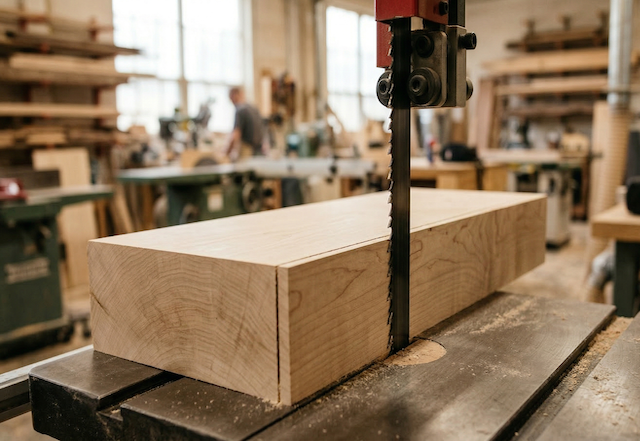
- ✅ Do Adjust Your Blade Guides: Lower the upper blade guide assembly so it sits just 5 mm to 10 mm above your workpiece. This minimizes blade deflection, keeps your cut perfectly straight, and exposes less of the dangerous moving blade.
- ✅ Do Check Your Blade Speed: Wood requires high cutting speeds to evacuate chips efficiently. Ensure your machine is set to wood-cutting speeds (typically 3,000 to 4,000 FPM) rather than slower metal-cutting speeds.
- ✅ Do Maintain Steady Feed Pressure: Let the blade do the work. Feed the wood smoothly and consistently, listening to the motor. If the machine sounds like it is bogging down, ease up on your feed rate immediately.
- ✅ Do Use Proper Dust Extraction: Deep cuts generate a massive volume of sawdust. A strong dust collection setup keeps the lower wheel housing clean and prevents the blade from slipping off the tires.
⚠️ The “Don’ts” of Bandsaw Woodworking
- ❌ Don’t Use a High TPI Blade for Thick Wood: Never use a blade meant for thin metal (like a 5/7 or 10 TPI blade) for deep wood cuts. The tiny gullets will instantly pack solid with sawdust, causing extreme friction that can wedge the blade tight and literally burn out your motor.
- ❌ Don’t Force a Dull Blade: If you find yourself having to push aggressively to get the wood through the machine, the blade is dull. Forcing it will only cause the blade to wander, overheat, and eventually snap.
- ❌ Don’t Ignore Blade Drift: Bandsaw blades naturally tend to pull slightly to one side. Do not force the wood perfectly straight against a standard flat fence if the blade wants to drift; instead, adjust your fence angle to match the blade’s natural cutting line.
- ❌ Don’t Back Out of Long Cuts While Running: If you need to stop and back out of a deep, long cut, turn the machine off first and let the blade come to a complete stop. Pulling wood backward on a moving blade can easily pull the blade right off the wheels.
- ❌ Don’t Overlook Belt Tension: A slipping drive belt will cause the blade to stall in the middle of a cut, which perfectly mimics an underpowered motor. Keep your belts properly tensioned and regularly inspected.
Looking for reliable, industrial-grade machinery that won’t let you down on the shop floor?
Upgrade your workshop with our heavy-duty bandsaws and precision tools designed for continuous production.


