Category

Technical Advisory

The Ultimate Guide to Machining Graphite Blocks on Vertical Bandsaws

By Technical Advisory No Comments

SUBJECT: Best Practices and Tooling Recommendations for Machining 250mm x 250mm Graphite Blocks on Vertical Bandsaws DATE: February 27, 2026


1. The Nature of Graphite Machining

While graphite is physically soft and cuts with little cutting force, it is an extremely abrasive material. Machining graphite is comparable to cutting compressed sand; it aggressively wears down the cutting edge of the blade. Furthermore, cutting graphite produces a fine, highly pervasive dust rather than traditional chips. This dust requires specialized handling to protect both the operator and the machine tool.

2. Bandsaw Blade Recommendations (M.K. Morse – Made in USA)

For a solid 250mm x 250mm cross-section, clearing the heavy volume of abrasive dust from the cut channel is the most critical factor. We highly recommend a coarse tooth pitch to provide adequate gullet capacity.

⭐ Primary Recommendation: M.K. Morse M-Factor GP (Carbide-Tipped)

Specification: 2/3 TPI (Teeth Per Inch).

Application: This is the optimal solution. The carbide-tipped teeth provide the extreme wear resistance required to withstand graphite’s abrasiveness. It ensures straight cuts, an excellent surface finish, and maximum blade life, ultimately delivering the lowest cost-per-cut and minimizing machine downtime.

⚠️ Alternative Option: M.K. Morse Independence EXS (Bi-Metal)

Specification: 2/3 TPI.

Application: If initial blade cost is an overriding constraint, this M42 high-speed steel blade can be used. However, please be advised that the abrasive nature of graphite will degrade the Bi-Metal cutting edge exponentially faster than Carbide, resulting in a significantly shorter blade life.

3. Cutting Parameters & Operational Guidelines

  • Cutting Environment (Strictly DRY): Graphite must be cut 100% dry. Never use liquid coolants. Mixing coolant with graphite dust creates a dense, highly abrasive slurry/paste that will rapidly destroy the bandsaw’s guides, bearings, and drive wheels.
  • Blade Speed:
    • With M-Factor GP (Carbide): 600 mpm to 1100 mpm. The high speed facilitates a smooth finish.
    • With IND EXS (Bi-Metal): 150 mpm to 500 mpm maximum. High speeds will immediately burn up a Bi-Metal blade due to friction.
  • Feed Rate: Maintain a moderate, steady feed. Ensure constant positive pressure so the teeth are actively shearing the material rather than rubbing against it.

4. Machine & Electrical Precautions (CRITICAL)

  • Conductivity: Graphite dust is highly electrically conductive. If airborne dust enters the bandsaw’s electrical cabinets, motors, or variable frequency drives (VFDs), it will cause catastrophic short circuits and equipment failure.
  • Sealing: Ensure all electrical enclosures on the machine are heavily sealed (IP65 rating or higher). If possible, positively pressurize the electrical cabinets with clean, dry air.
  • Mechanical Protection: Exposed linear guides, ball screws, and bearings should be protected with bellows or heavy-duty wipers to prevent the abrasive dust from acting as a grinding compound on the machine’s moving parts.

5. Dust Collection & Operator Safety

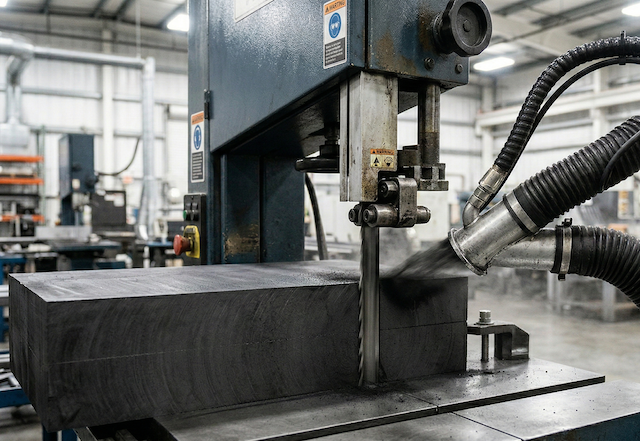
  • Extraction: A high-velocity industrial dust collector or vacuum system positioned directly at the cutting zone is mandatory to capture the dust before it becomes airborne.
  • Respiratory Protection: Operators must wear high-efficiency particulate respirators (N95, P100, or equivalent FFP3 masks). Prolonged inhalation of fine graphite dust poses a significant respiratory health risk.
  • Eye & Skin Protection: Tight-fitting safety goggles (unvented or indirectly vented) must be worn to prevent dust from scratching the eyes. Long sleeves and industrial barrier gloves are recommended to prevent skin irritation from the fine particulate.

To buy the above mentioned Blades / Machines or more technical details, contact us – https://maxmachines.in/contact/

IMPORTANT DISCLAIMER & LIMITATION OF LIABILITY

The information, parameters, and recommendations provided in this Technical Advisory Circular are intended as general guidelines based on industry best practices and tooling manufacturer specifications. Actual machining results and tool life may vary significantly depending on the specific machine condition, material composition, ambient environment, and operator skill.

Max Machine Tools provides this information solely as a courtesy to our customers. We assume no liability or responsibility for any machine damage, tooling failure, loss of production, or personal injury resulting from the application or misapplication of these guidelines. Customers and operators are solely responsible for ensuring safe operating procedures, verifying parameters before production, and maintaining proper safety and extraction equipment within their facilities.

WhatsApp chat